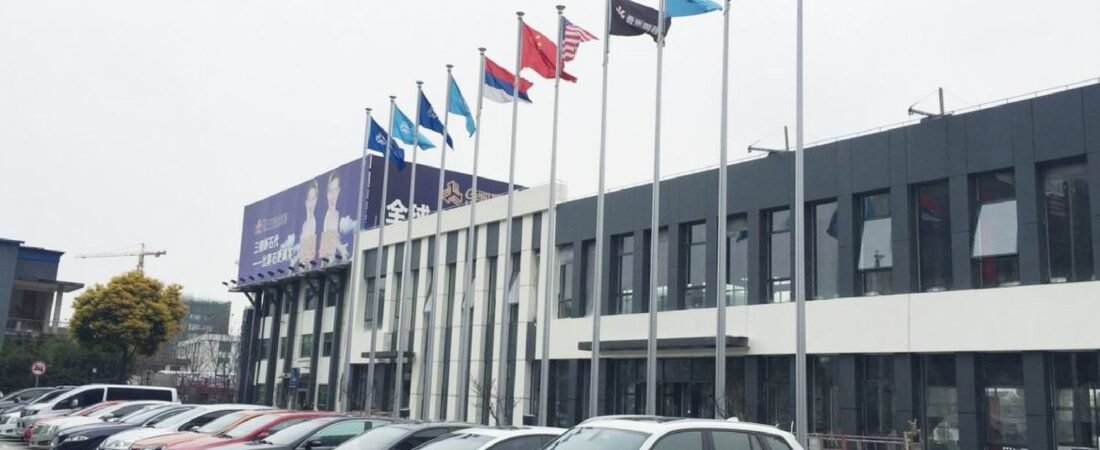

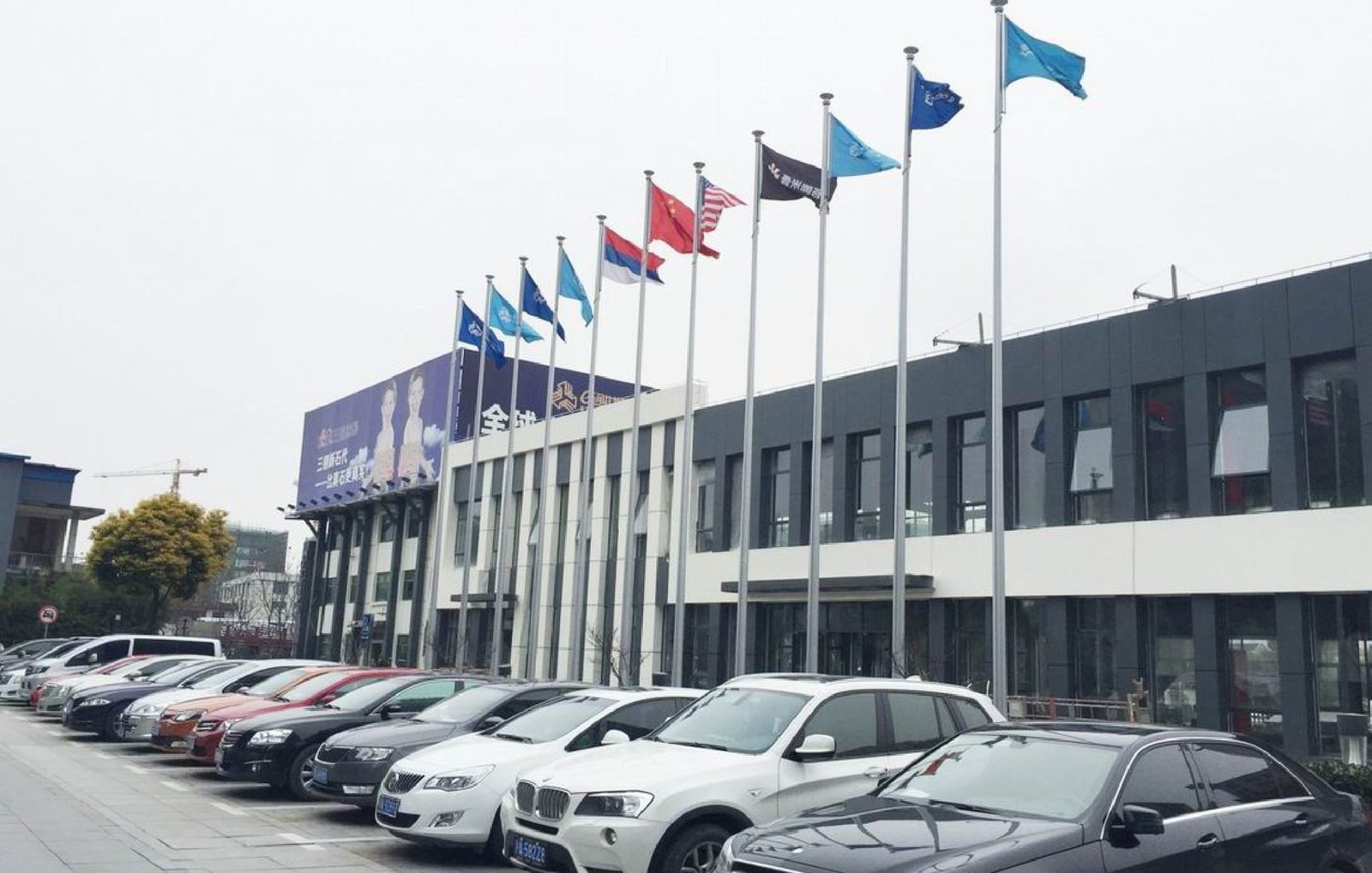
Most flagpole enquiries start with a height and a quantity. That is the right place to begin, but height alone does not determine the product. Three decisions sit behind it, and getting them wrong is what makes a flagpole expensive later: the shaft material, the operating system, and the way the pole is fixed to the ground.
1. Decide the material from the environment, not the price list
Aluminum and stainless steel are both corrosion-resistant, and the price difference between them is smaller than the difference in maintenance over twenty years.
- Aluminum (6063-T6) weighs roughly a third of an equivalent steel shaft. That reduces crane time, foundation load and installation cost, which is why it dominates campus, retail and residential projects. Anodizing gives a sealed surface that does not need repainting.
- Stainless steel (SS304 / SS316L) is chosen where the pole is part of the architecture. SS304 is adequate inland; SS316L is the correct specification for coastal sites, high-chloride environments and marine locations.
- Structural steel only makes sense above roughly 30 m, where the shaft becomes a structure with calculated sections and a designed foundation.
A practical rule: if the pole will be within a few kilometres of the sea, specify SS316L or a properly anodized aluminum shaft, and insist on stainless fittings throughout. Zinc-plated fasteners are the first thing to fail on a coastal installation.
2. Fix the height using the flag, not the building
The common rule of thumb is that the flag length should be about one quarter to one third of the pole height. If the client wants a very large flag on a modest pole, the shaft and base plate have to be sized for the additional drag, not for the height alone.
Two constraints usually decide the final figure:
- Visual proportion against the building or plaza. A pole that is too short for the space reads as an afterthought.
- Structural practicality at the chosen height. Above about 24 m the shaft generally ships in sections, which changes transport and erection.
3. Choose manual or electric by who operates it
This is the decision most often made for the wrong reason. A manual halyard is not a cheap alternative to an electric pole — it is the better choice for sites where the flag is raised on specific occasions.
- Manual halyard suits institutional and ceremonial sites, low-frequency operation, and any location where a power supply at the base is difficult. Internal routing conceals the rope and secures it behind a lockable door; external routing is easier to inspect.
- Electric suits poles raised daily, poles above roughly 20 m where manual handling becomes a two-person job, and sites where the operator is not a technician. A wind sensor with automatic retraction should be standard, not optional.
4. Do not separate the pole from its foundation
The most expensive failures happen at the base. The pole, base plate, anchor group and foundation need to be designed together against the actual soil and wind conditions. Ask for the anchor bolt template before the concrete is poured — if it arrives with the pole, the foundation is already wrong.
What to put in the enquiry
A supplier can only quote accurately if the enquiry contains: required height and quantity, flag size, installation location and design wind speed, preferred material and finish, manual or electric operation, foundation condition, and destination port. With those seven points, a specification proposal is normally possible without a second round of questions.
Need a specification review for your project?
Send the height, quantity, flag size and site location. We will confirm what the pole needs to be.