

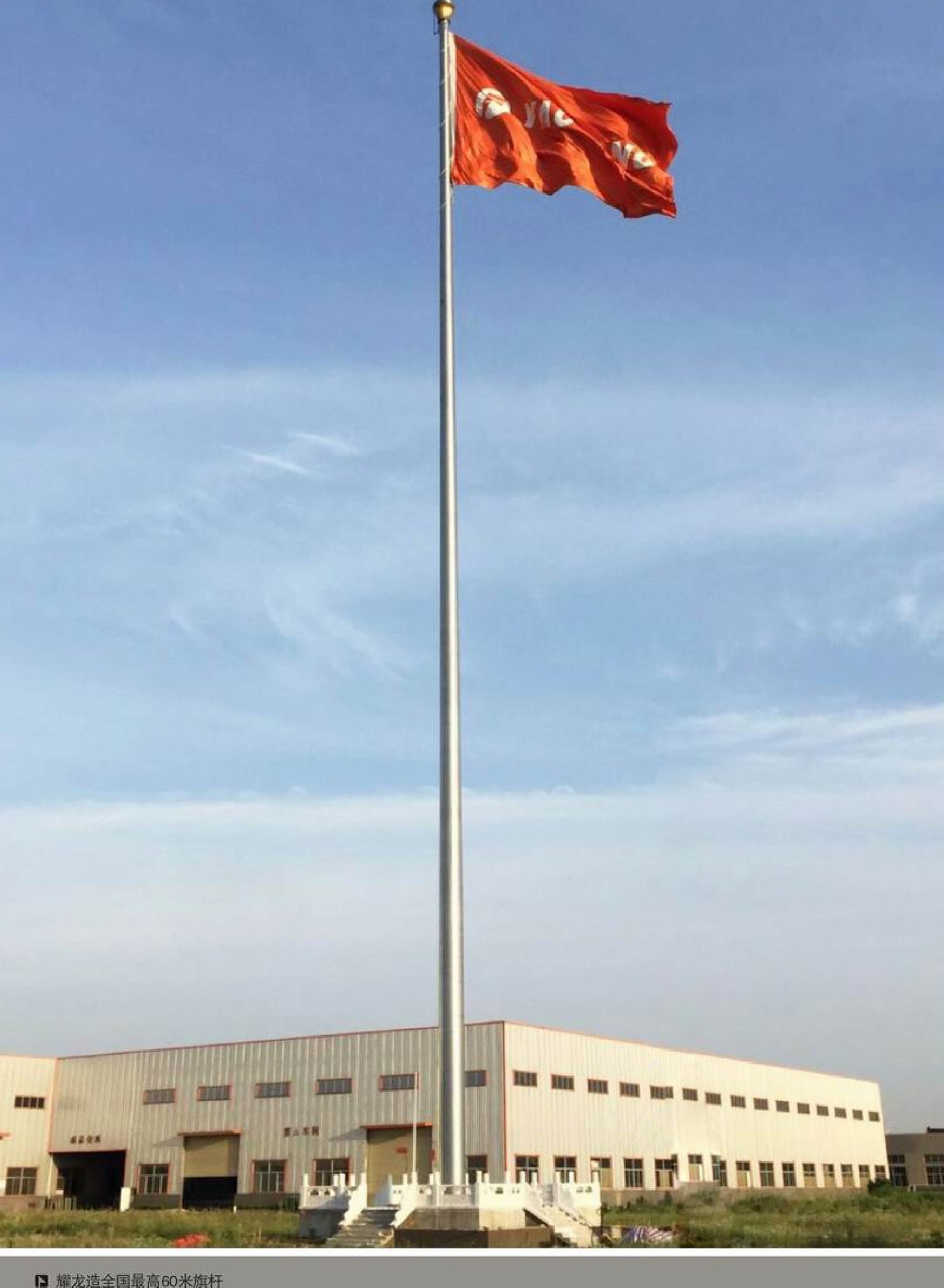
Two identical poles installed two kilometres apart can require different wall thicknesses and different base plates. This is not a supplier being difficult; it is how a cantilever structure behaves. Wind speed, terrain exposure, flag area and soil capacity all feed the calculation.
What actually loads the pole
- Wind on the shaft — a function of design wind speed, shaft diameter and height. Because the pole is a cantilever, the bending moment at the base grows roughly with the square of the height.
- Wind on the flag — often larger than the shaft load for a big flag, and dynamic. A flag that snaps in gusting conditions applies a repeated load that a static calculation underestimates.
- Self weight and ice in cold regions, which some markets require to be considered explicitly.
- Seismic action in zones where the local code requires it, particularly for tall poles with heavy finials.
Why “rated to 150 mph” is not enough
A series rating tells you what the standard shaft can withstand in a defined configuration. It does not tell you whether that shaft, at your height, with your flag, on your soil, is adequate. For anything above roughly 20 m — and for any pole on a public project — ask for a project-specific calculation rather than a catalogue figure.
The four documents a consultant will ask for
- Shaft calculation — bending, deflection and section check at the design wind speed, against the code named in the specification (ASCE 7-16, EN 1991-1-4 or the local equivalent).
- Base plate and anchor design — plate thickness, bolt diameter, embedment and edge distance, checked against the foundation drawing.
- Foundation interface drawing — setting-out, anchor bolt template, embedded parts and the required concrete strength.
- Material certificates — mill certificates for plate and tube, so the grade in the calculation is the grade in the pole.
What the buyer should confirm early
Three questions, asked before the order, prevent almost all site problems:
- What design wind speed applies, and from which code?
- Who is responsible for the foundation — the pole supplier, the civil contractor, or a structural engineer?
- When will the anchor bolt template be available relative to the concrete pour?
On our own projects we issue the template with the approved drawing, before fabrication, precisely so the foundation is not cast against an assumed bolt circle.
Need a specification review for your project?
Send the height, quantity, flag size and site location. We will confirm what the pole needs to be.